
Why DidjaKnow Separates Evidence From Interpretation
Understanding the difference between physical evidence and interpretation allows archaeological discoveries to be examined objectively while keeping multiple explanations open for investigation.
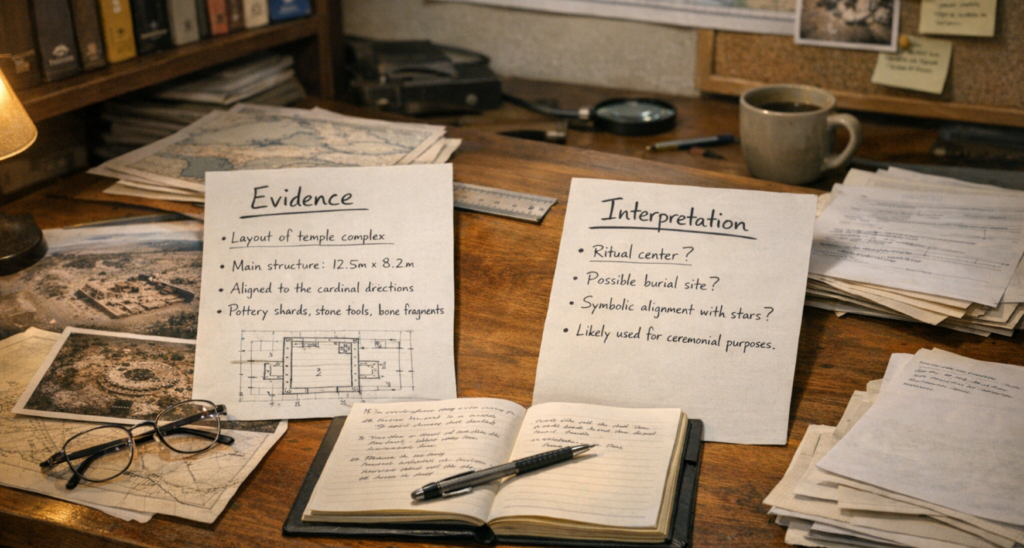
Context
In archaeology and ancient history, the distinction between evidence and interpretation is essential. Physical evidence—such as structures, measurements, and alignments—exists independently of the explanations built around it.
The distinction between evidence vs interpretation in archaeology is essential when examining ancient structures, alignments, and historical claims.
Understanding the difference between evidence and interpretation in archaeology helps investigators evaluate competing explanations without confusing observation with conclusion.
Observation
In many public debates, physical evidence and interpretive conclusions are treated as inseparable. Stones, structures, measurements, and alignments are often presented alongside a single explanatory narrative, as though the interpretation is an extension of the evidence itself.
DidjaKnow deliberately separates these layers. Physical evidence is documented first. Interpretive frameworks — whether mainstream or alternative — are then explored as models rather than immediate conclusions.
This distinction also explains why many research observations never become full episodes, as explained in the DidjaKnow field note on why not every insight becomes an episode.
Why It Matters
Failing to separate evidence from interpretation leads to false certainty. By distinguishing what exists from what is inferred, DidjaKnow allows multiple explanations to be evaluated without prematurely closing inquiry.
Careful investigation — in both scientific research and historical analysis — relies on separating observation from interpretation, a principle widely recognised in the philosophy of science.
Responsible research practice emphasises evaluating evidence independently before proposing explanatory models.
These principles guide every DidjaKnow investigation, including the documented research processes used across the project.
Status
Methodological clarification