
Clarifying “Unresolved” — What DidjaKnow Means (and Doesn’t Mean)
In DidjaKnow investigations, the term **“unresolved” refers to historical or scientific questions where available evidence remains incomplete, contested, or open to multiple interpretations.
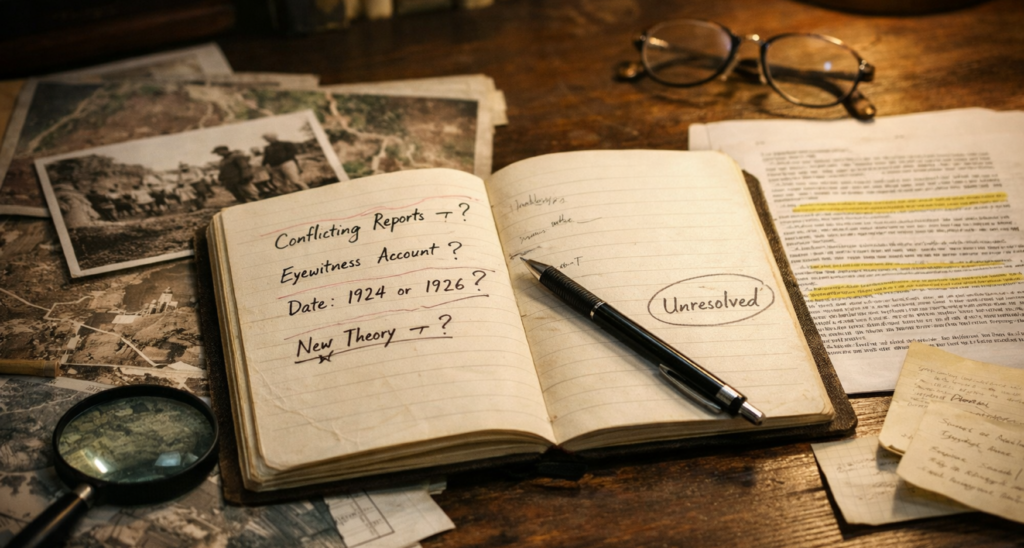
What does “unresolved” mean in a DidjaKnow investigation? This clarification applies across multiple DidjaKnow investigations, including early episodes collected in the Unresolved Earth eBook, where competing interpretations are examined alongside the available evidence.
What “Unresolved” Means in DidjaKnow Investigations
Observation
In DidjaKnow investigations, the term unresolved does not imply that any explanation—mainstream or alternative—has been proven correct or incorrect. It indicates that key questions remain open, contested, or insufficiently constrained by available evidence.
Many debates in archaeology, geology, and ancient history persist not because of fringe speculation, but because data is incomplete, degraded, or interpreted through competing frameworks.
Historical and scientific research routinely deals with incomplete evidence, and uncertainty is recognised as a normal part of investigation (see the Royal Society discussion of scientific uncertainty). Broader explanations of how evidence, uncertainty, and competing interpretations operate within scientific reasoning are discussed in the Stanford Encyclopedia of Philosophy’s overview of the scientific method.
Why It Matters
Treating unresolved questions as either “solved” or “debunked” often obscures the real state of inquiry. DidjaKnow focuses on documenting where certainty ends and interpretation begins, without forcing conclusions for narrative convenience.
Supporting documentation and expanded investigation material for these topics can be found within the DidjaKnow Research Files archive.
Status
Contextual clarification only
In complex historical and scientific investigations, some questions remain open for decades or even centuries. Recognising when evidence is incomplete is not a weakness of research but an essential part of intellectual honesty. DidjaKnow investigations document these open questions so readers can understand where knowledge ends and inquiry continues.