
When Multiple Explanations Can Coexist
When evidence does not clearly support a single conclusion, multiple explanations Can Coexist. In historical and archaeological research, investigators often evaluate several interpretations simultaneously while new evidence continues to emerge.
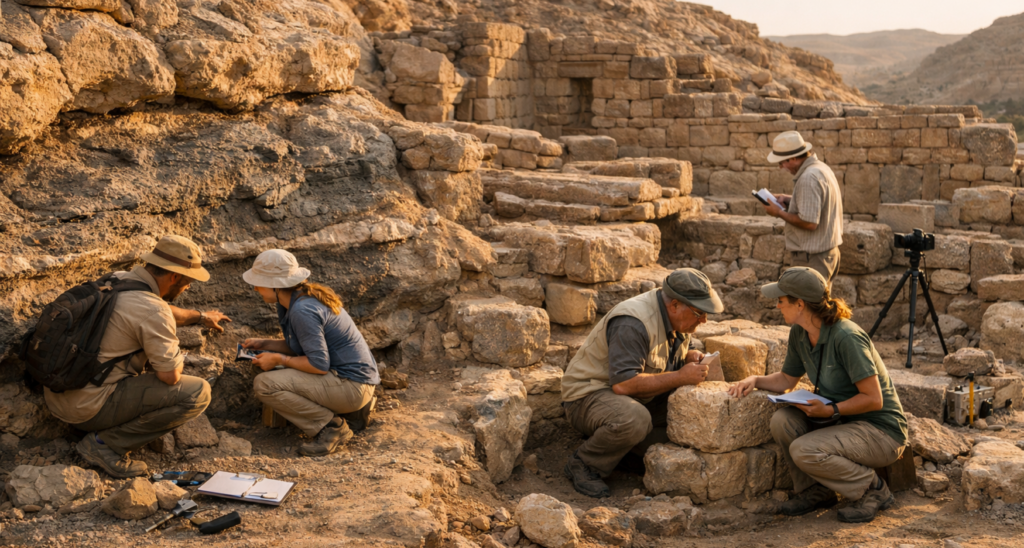
Understanding this principle helps explain why debates can persist around ancient sites, artefacts, and historical events.
Context
Many historical investigations involve incomplete evidence. Archaeological records can be fragmentary, environmental processes may alter sites over time, and written sources can reflect the perspectives of particular cultures or periods.
As a result, researchers sometimes propose competing interpretations that attempt to explain the same observations.
These interpretations may originate from several investigative perspectives, including:
- mainstream academic frameworks
- alternative or emerging hypotheses
- interdisciplinary analysis involving geology, anthropology, or cultural history
DidjaKnow Media examines both established and alternative interpretations while emphasising evidence-based reasoning.
Observation
In complex historical systems, multiple explanations can remain plausible at the same time.
Example Interpretations:
- Geological processes may explain certain formations while cultural activity explains others.
- Human construction may coexist with natural modification over long time periods.
- Different cultures may interpret the same structures in different ways.
This situation often arises when investigators confront absence of evidence in historical claims, where missing data limits the ability to reach definitive conclusions.
Rather than forcing a single conclusion prematurely, responsible research evaluates how well each explanation accounts for the available evidence.
Why It Matters
Insisting on only one explanation can oversimplify complex historical processes.
Allowing several interpretations to remain under consideration reflects the reality of scientific and historical investigation. Over time, additional evidence may support, refine, or reject competing hypotheses.
Understanding how interpretations develop also helps explain why debates sometimes occur between researchers working within different theoretical frameworks.
For a broader discussion of how researchers interpret incomplete records, see:
→ Absence of Evidence in Historical Claims
Investigative Approach
At DidjaKnow Media, investigations follow several guiding principles:
- examine the available evidence
- consider competing interpretations
- recognise the limits of current knowledge
- remain open to revision when new evidence appears
This approach allows both established and alternative explanations to be evaluated without assuming conclusions in advance.
For more detail on this investigative philosophy see:
Methodology
Historical interpretation involves analysing multiple types of evidence including archaeological data, geological processes, cultural records, and scientific dating methods.
Researchers compare how different explanations account for observable evidence while also considering the limitations of available data.
Where evidence is incomplete, several interpretations may remain under discussion until additional discoveries provide greater clarity.
Further Reading
External perspectives on interpretation and historical methodology include:
→ Stanford Encyclopedia of Philosophy — Scientific Method
→ Smithsonian Magazine — How Archaeologists Interpret the Past
Status
Interpretive clarification