
Why DidjaKnow Does Not “Debunk” for Closure
This field note explains why DidjaKnow focuses on examining evidence and competing interpretations rather than declaring final “debunked” conclusions in unresolved historical investigations.
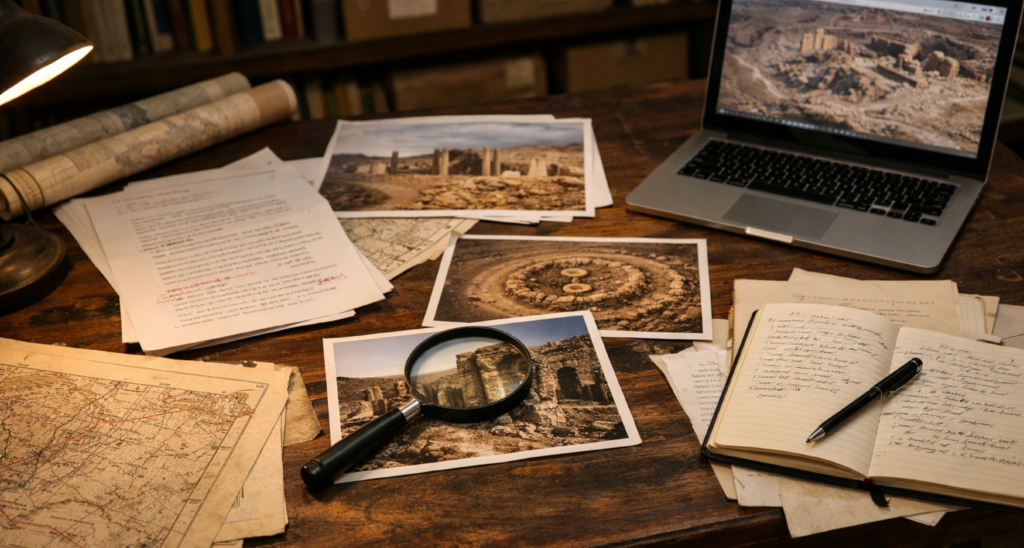
Debunking historical claims is often presented as the final stage of investigation, yet many historical questions remain open because evidence can support more than one interpretation.
Context
Applies to the overall editorial philosophy of DidjaKnow.
Methodology
DidjaKnow investigations examine available evidence, review mainstream research, and consider alternative interpretations where questions remain unresolved. The goal is not to force definitive conclusions, but to document how evidence is interpreted and where genuine uncertainty still exists.
Debunking Historical Claims in Investigation
Debunking is often framed as the final step in inquiry, implying that a question has been conclusively resolved. In practice, many historical and geological debates remain open because available evidence can support multiple interpretations or may still be incomplete.
Historical investigation often requires evaluating different interpretations when evidence is incomplete.
This is why DidjaKnow separates observation from interpretation when examining historical evidence.
Within archaeology and historical research, some investigators favour cautious interpretations grounded in established evidence, while others explore alternative explanations when anomalies or unresolved questions appear. While others explore alternative explanations when anomalies or unresolved questions appear in the data.
DidjaKnow does not treat debunking as a final endpoint. Instead, investigations focus on documenting the evidence, explaining how different interpretations arise, and identifying where genuine uncertainty still exists.
Why It Matters
Replacing uncertainty with forced resolution can be as misleading as uncritical speculation. Maintaining open questions preserves intellectual honesty and invites continued investigation.
Scientific inquiry itself develops through testing, debate, and revision as new evidence emerges.
This perspective also explains why some archaeological discoveries generate ongoing public debate.
Status
Editorial clarification