The Library of Alexandria: What Was Lost? (UF-017)
$ 5.90
A focused investigation into ancient knowledge loss that appear impossible, yet are grounded in natural science.
04:59 runtime • Digital Audio • Ancient History / Lost Knowledge / Historical Mysteries
The Library of Alexandria stands as one of history’s most haunting symbols of lost knowledge, remembered not only for what it held, but for what humanity may never recover.
In this Unknown Files investigation, the story begins with the ancient library’s rise under the early Ptolemies and its place at the center of the Hellenistic world.
Scholars were drawn to Alexandria by the idea that knowledge could be gathered, copied, tested, and passed on across generations.
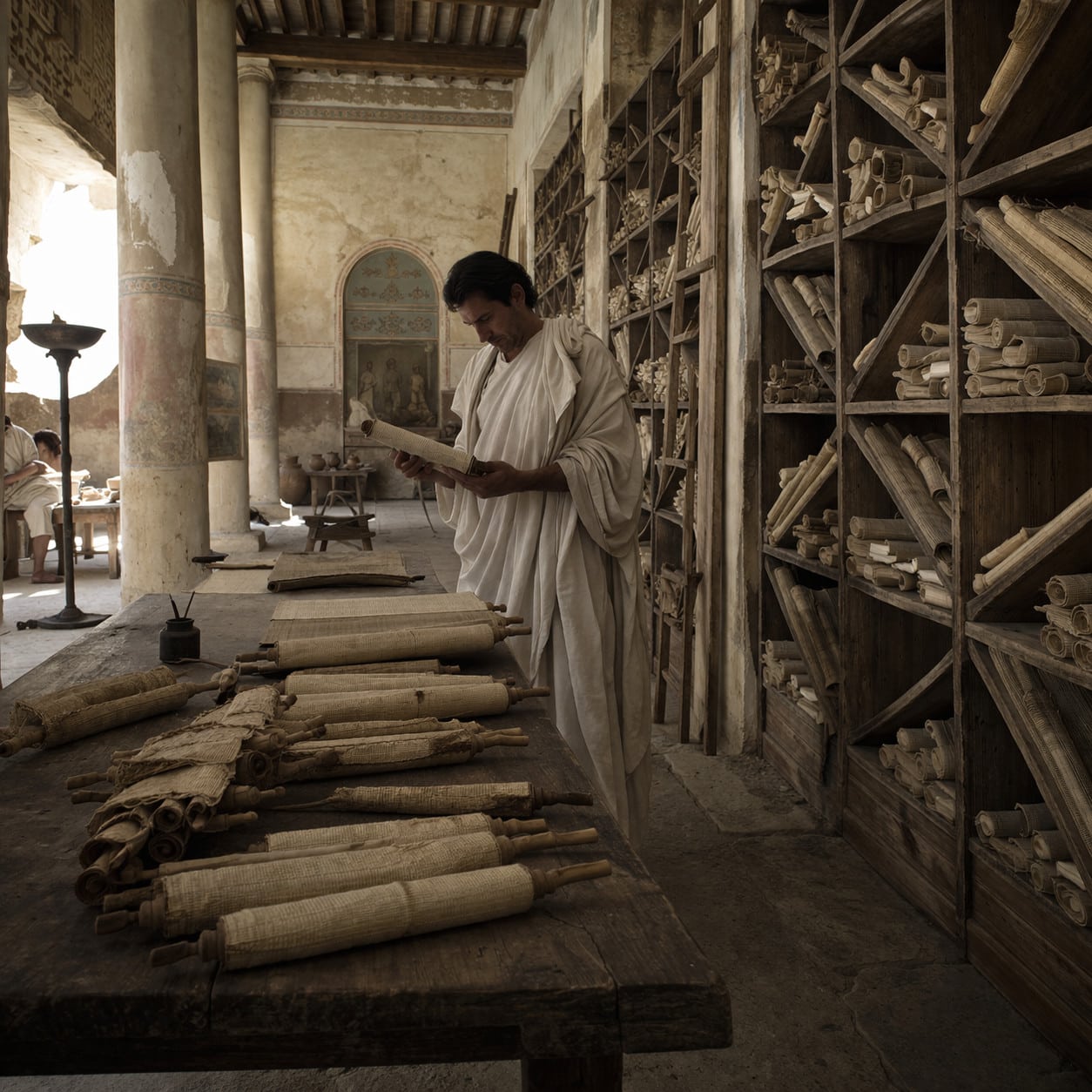
Ancient estimates suggest the library may have held hundreds of thousands of scrolls, though the true number remains uncertain.
What made it extraordinary was not only scale, but content: mathematics, astronomy, medicine, geography, philosophy, drama, and history.
Figures associated with Alexandria include Euclid and Eratosthenes, while the city’s wider intellectual world also touched minds such as Archimedes.
This was not simply a building filled with texts. It was a research culture, where ideas were debated, expanded, and preserved through scholarly work.
The familiar story of a single catastrophic fire remains powerful, but the historical record is far less certain.
Mainstream history does not support the idea that the entire Library of Alexandria vanished in one night. Instead, historians point to repeated damage, political instability, and long institutional decline.
Julius Caesar’s campaign in Alexandria in 48 BCE is often placed at the center of the story, yet whether that fire destroyed the main library itself remains debated.
Later centuries brought urban conflict, shifts in power, and the weakening of the scholarly environment that once made Alexandria exceptional.
That slower explanation may be less dramatic, but it is more unsettling. It suggests that one of humanity’s greatest storehouses of knowledge may have disappeared piece by piece.
Only a fraction of ancient literature has survived into the modern world, and many lost works are known only through fragments, titles, or references in later authors.
This investigation also considers the broader human response to that loss: not fantasies of impossible technology, but the real possibility that far more ancient knowledge once existed than the surviving record now shows.
Mainstream scholars remain careful for good reason. There is no evidence that Alexandria preserved miraculous machines or science centuries ahead of its age.
But even without exaggeration, the loss remains immense. If commentary, observation, experiment, and interpretation vanished with those scrolls, then our picture of the ancient world is necessarily incomplete.
The Library of Alexandria still resonates because it represents a deeper fear: that human beings may once have recorded things that history can no longer recover.
This recording is presented as a clean, uninterrupted studio narration designed for focused listening and offline playback.
Format: Digital audio file (M4A)
Delivery: Instant download after purchase
Edition: Official Audio Edition — Unknown Files Investigation
Explore more investigations on the Episodes page.
Browse the full series in the Unknown Files collection.
For historical and archaeological context on ancient Alexandria and Hellenistic scholarship, refer to resources from the British Museum and the Metropolitan Museum of Art.