
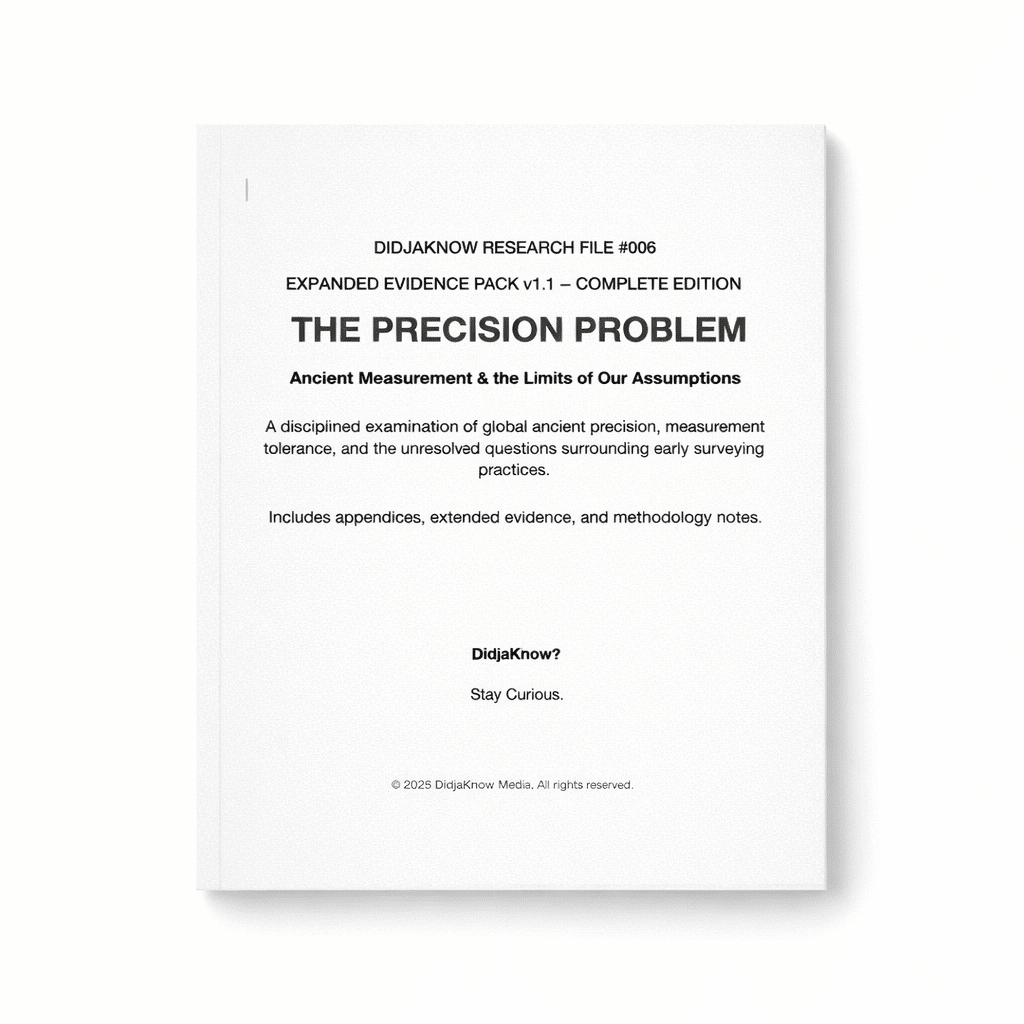
The Precision Problem — Ancient Measurement & the Limits of Our Assumptions — Expanded Evidence Pack
$ 19.00
Disciplined examination of measurable ancient precision, tolerance control, and the unresolved technical questions surrounding early surveying practices.
32-page illustrated PDF • Expanded Evidence Pack • Archaeology, measurement science, surveying tolerances
This Research File supports EP06 — The Precision Problem: Ancient Measurement & the Limits of Our Assumptions.
Across the ancient world, monumental structures display levels of geometric, directional, and dimensional precision that remain difficult to explain using simple construction narratives alone.
This publication is the Expanded Evidence Pack edition of the DidjaKnow research file examining ancient measurement precision — not scale, beauty, or symbolism, but measurable control: alignment accuracy, tolerance consistency, levelness across distance, and repeatability across unrelated cultures.
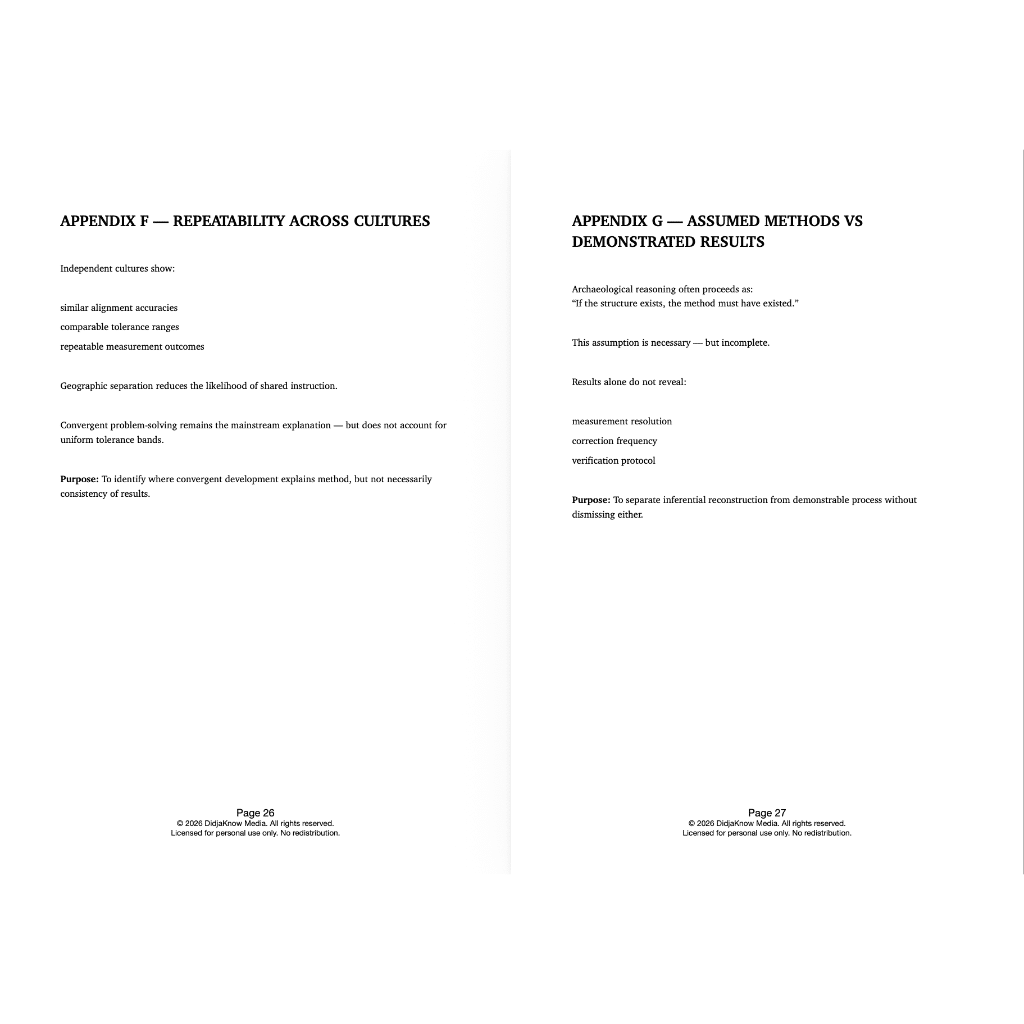
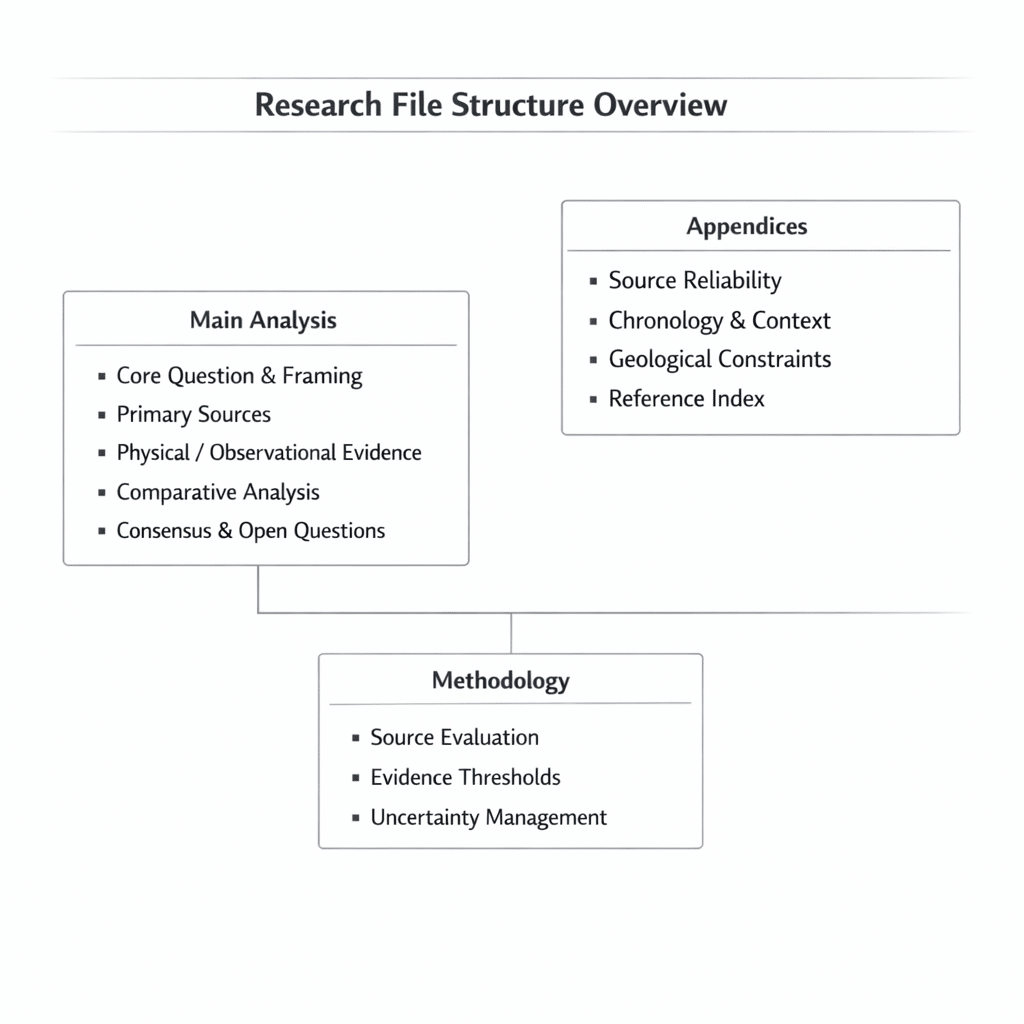
The investigation applies a disciplined, archaeology-first and engineering-aware framework. It documents where ancient precision is demonstrably measurable, where mainstream archaeology provides strong explanatory models, and where explanation becomes strained without collapsing into speculation. The file explicitly distinguishes demonstrated results from assumed methods, maintaining clear boundaries between evidence, inference, and unresolved technical questions.
The expanded analysis examines globally distributed case studies — including Giza, Teotihuacán, the Indus Valley, and Angkor — showing that precise outcomes recur across cultures separated by geography, language, and time. Rather than dismissing ancient capability or invoking lost technologies, the research focuses on the central unresolved issue: how fine-scale error detection and correction were achieved without modern instruments.
Extended sections address compounding error, tolerance management, baseline levelling, and the absence of surviving technical documentation. Where explanations remain incomplete, they are identified honestly as open technical problems, not ideological gaps or suppressed knowledge.
Included investigations and materials cover:
-
Definition of precision as a measurable engineering concept
-
Global examples of ancient alignment and tolerance control
-
Giza as a legitimate measurement anchor
-
Repeatability of precision across unrelated cultures
-
Mainstream explanations that work — and where limits appear
-
Compound error and scale-related technical challenges
-
Measurement without modern instruments
-
Assumption vs reconstruction in archaeological reasoning
-
Absence of technical documentation and its implications
-
Clear boundaries against speculative technology claims
-
Legitimate open research questions
-
Expanded technical appendices on alignment, levelling, tolerances, and error control
-
Evidence vs interpretation summaries
-
Primary source start points for further investigation
This Expanded Evidence Pack does not propose advanced lost machines, extraterrestrial intervention, or erased super-civilisations. It argues only that ancient measurement knowledge may be under-reconstructed — not impossible, mystical, or anachronistic.
It is intended for readers who want a technically grounded, methodologically transparent understanding of why ancient precision matters, what is genuinely explained, and where careful uncertainty remains.
The document is written as a long-form reference file, not as a narrative or speculative reinterpretation.
Format: Digital eBook (PDF)
Delivery: Instant download after purchase
Edition: Expanded Evidence Pack v1.1 — Complete Edition
Related products
-
Research Files
Teotihuacán — Tunnels, Liquid Mercury & Hidden Chambers (Part 2) — Research File
$ 12.00 Add to cart
Reviews
There are no reviews yet.