

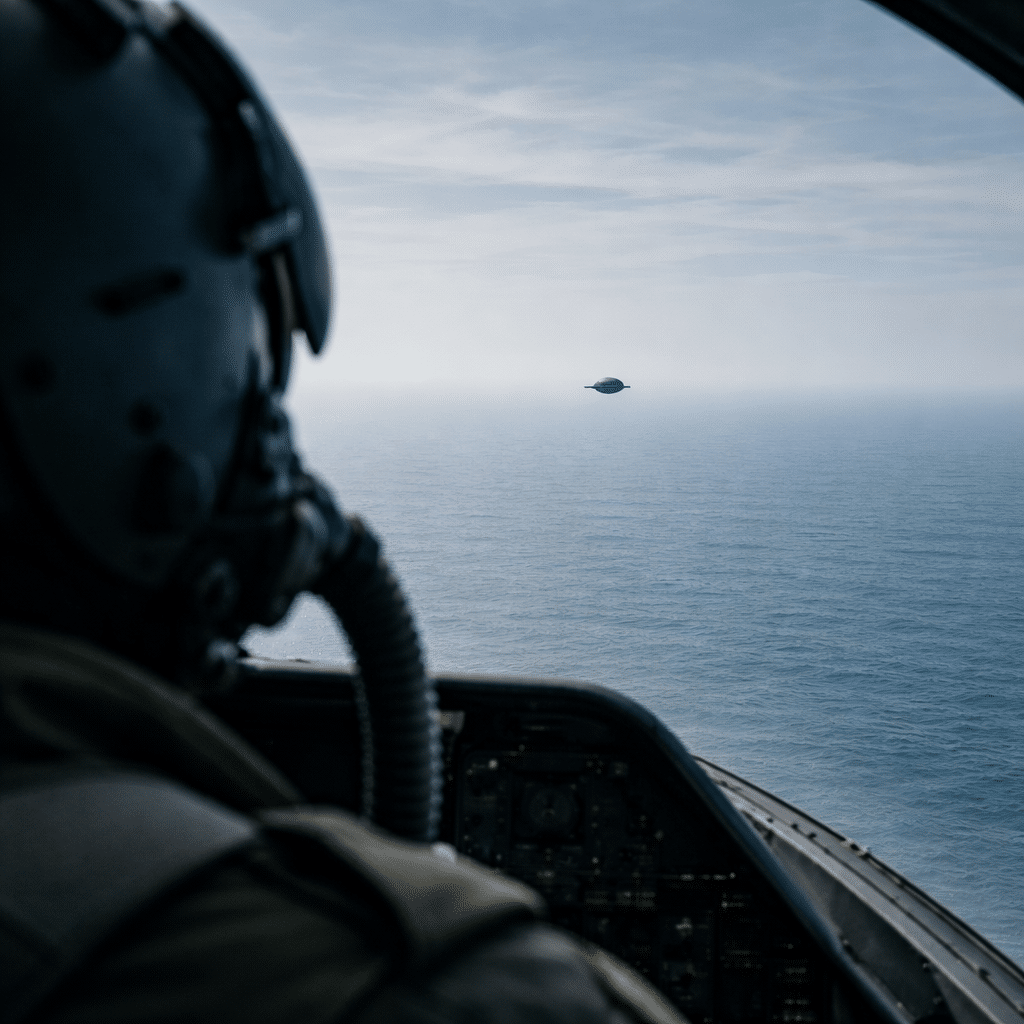
Roosevelt Sightings: Repeated Encounters in Military Airspace (UF-002)
$ 5.90
A focused investigation into the Roosevelt UAP sightings, examining pilot testimony, radar contacts, infrared footage, sensor geometry, and the limits of the publicly available evidence.
04:54 runtime • Digital Audio • Military UAP / Naval Encounters / Aerial Anomalies
The Roosevelt sightings became one of the most significant modern military UAP cases because they involved repeated reports from naval aviators, radar contacts, infrared footage, and encounters inside controlled training airspace.
Between two thousand and fourteen and two thousand and fifteen, aviators attached to the USS Theodore Roosevelt strike group reported unfamiliar objects during training off the United States East Coast.
These were not repeated sightings of one confirmed object. Different pilots described separate incidents involving radar contacts, visual observations, and infrared recordings.
One of the most concerning accounts involved an object described as a dark cube enclosed within a transparent sphere passing between two aircraft. The reported encounter created an immediate flight-safety concern because the crews had received no warning that another object was in their path.
Pilots also reported that unusual radar contacts became increasingly common after upgraded sensor systems were introduced. This raised an important question: were the improved systems detecting objects previously missed, revealing unfamiliar sensor behaviour, or recording a genuine change within the training environment?
The complete underlying records have not been released publicly, making those possibilities difficult to separate.
The investigation also examines the famous Navy recordings associated with the Roosevelt period. GIMBAL remains publicly unidentified, although the available footage does not establish the object’s size, distance, or true movement with certainty. Its apparent rotation may also have been influenced by the infrared imaging system.
GOFAST has received a different assessment. Analysis of the display geometry concluded that the object was not travelling at extraordinary speed and that much of its apparent motion resulted from parallax created by the movement of the observing aircraft.
This does not establish that every Roosevelt report had an ordinary explanation. It demonstrates that apparently extraordinary motion can sometimes be reduced when the sensor geometry is reconstructed correctly.
Other reports, including repeated radar contacts and close visual encounters, remain difficult to assess because the complete original data has not been made public.
The Roosevelt sightings therefore do not lead to one simple conclusion. Some elements may have conventional explanations, others remain unresolved, and none of the publicly available evidence proves extraterrestrial technology.
What the case clearly exposed was a weakness in military reporting. Pilots were encountering objects or sensor presentations they could not immediately identify, while stigma, incomplete records, and inconsistent procedures made the incidents difficult to compare and investigate.
The lasting lesson is not that every unknown object is extraordinary. It is that uncertainty must be documented properly before it can be resolved.
This recording is presented as a clean, uninterrupted studio narration designed for focused listening and offline playback.
Format: Digital audio file (M4A)
Delivery: Instant download after purchase
Edition: Official Audio Edition — Unknown Files Investigation
Explore more investigations on the Episodes page.
Browse the full series in the Unknown Files collection.


