
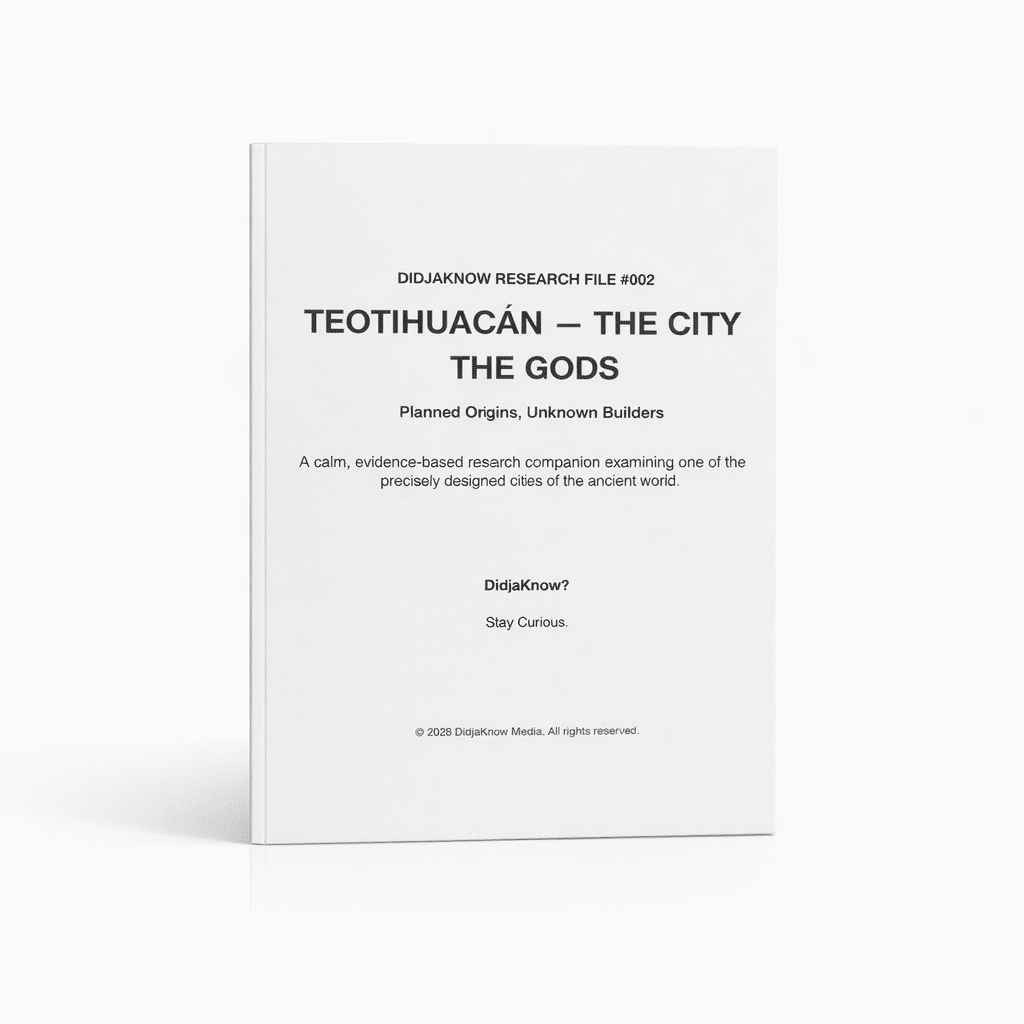
Teotihuacán — The City of the Gods
$ 12.00
Evidence-based examination of Teotihuacán’s master planning, 15.5° alignment, governance structure, and enduring archaeological uncertainties.
20-page illustrated PDF • Standard Research File • Archaeology, Urban Planning, Mesoamerica, Alignment Studies
This Research File supports EP02 — Teotihuacán: The City of the Gods.
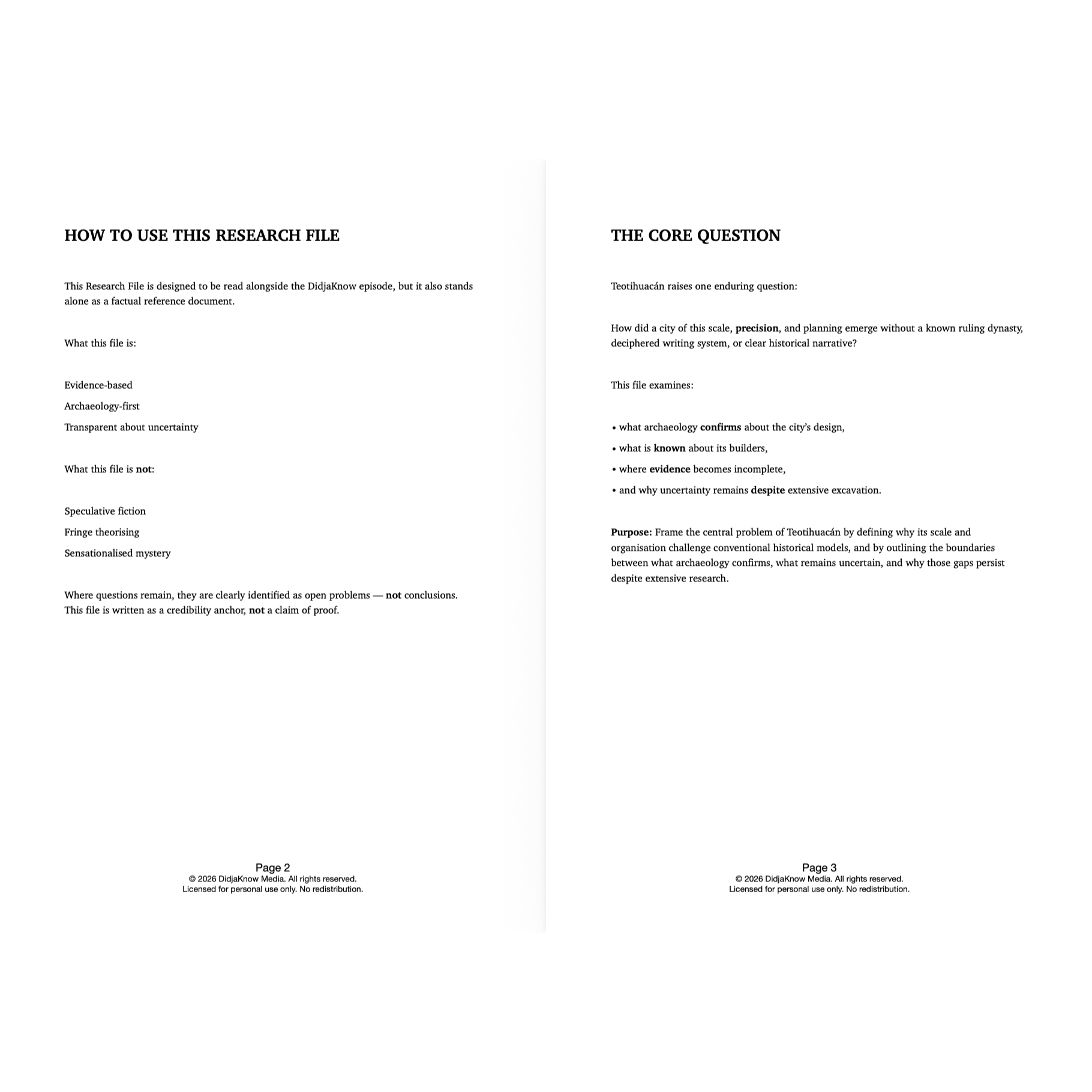
How did a city of this scale, precision, and long-term planning emerge without a known ruling dynasty, deciphered writing system, or clear historical narrative?
This publication is the standard DidjaKnow Research File examining Teotihuacán, one of the most precisely designed cities of the ancient world. It is designed to be read alongside the DidjaKnow episode, while also standing alone as a factual reference document.
The research follows a calm, evidence-based, archaeology-first approach. It draws directly from excavation data, architectural survey, material analysis, and comparative urban studies to document what is known about Teotihuacán’s design, organisation, and development, while clearly identifying where evidence becomes incomplete.
The file examines Teotihuacán’s geographic setting, construction chronology, and master-planned grid. It documents the Avenue of the Dead as the city’s organising axis, the consistent 15.5° alignment across structures, and the roles of the Pyramid of the Sun, Pyramid of the Moon, and Temple of the Feathered Serpent. Residential compounds, multi-ethnic population evidence, engineering methods without metal tools, water management systems, and governance models are evaluated conservatively within established archaeological constraints.
Throughout, the research distinguishes between confirmed evidence, plausible interpretations, and unresolved gaps. Uncertainty is treated as an empirical condition rather than a mystery to be resolved through speculation.
Included sections address:
-
The core question framing Teotihuacán
-
Archaeological evidence for city-wide planning
-
Geographic advantages and environmental constraints
-
Construction chronology and expansion phases
-
Urban coherence and standardisation
-
The Avenue of the Dead and spatial organisation
-
The 15.5° city-wide alignment
-
Major ceremonial structures and their roles
-
Residential compounds and social organisation
-
Population diversity and integration
-
Engineering and hydraulic infrastructure
-
Governance without identifiable rulers
-
Evidence for decline and internal collapse
-
Mainstream consensus and open questions
This research file does not claim unknown builders, does not propose lost technologies, and does not attempt to resolve unanswered questions beyond available evidence. It is written as a credibility anchor, not a claim of proof.
It is intended for readers seeking a clear, disciplined overview of Teotihuacán grounded in archaeology, without extended appendices or methodological expansion.
The document is structured for careful reading and reference rather than narrative or speculative interpretation.
Format: Digital eBook (PDF)
Delivery: Instant download after purchase
Edition: First Digital Edition
Reviews
There are no reviews yet.